
By Orient-Tapis Prestige, Paris 7th · · 5 min read
Key points
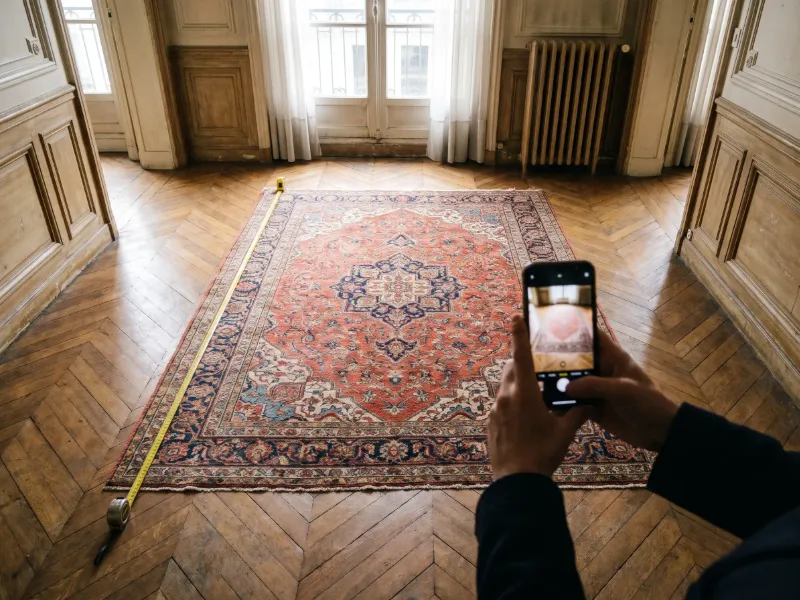
- Four views are enough to start: the whole rug from above, the back, a close-up of the pile and a close-up of the back next to a tape measure.
- Shoot in daylight, without flash, holding the phone level above the rug so nothing is distorted.
- Add the size without fringes, any visible damage and whatever you know about the rug’s history.
Why the photos decide how accurate a valuation can be
On a screen, two rugs of the same size and colours can look almost identical. One may still come from ordinary commercial production and the other from a city workshop with very fine knotting. What separates them shows up in specific places: the back, the base of the pile, the sides and the ends. If those places are missing from your photos, we can only give a wide range, and we will tell you so.
A well-taken set of pictures, on the other hand, lets us suggest a likely origin, judge how dense the knotting is and spot old repairs. That makes the exchange useful before anyone travels: you know whether the rug deserves a proper look, and we know what to check when we arrive. The points we assess are listed on our page about buying and valuing oriental rugs.
Setting up the rug and the light
Before you pick up your phone, spend five minutes preparing the room.
- Lay the rug flat and fully unrolled. Move the coffee table and the chairs. A folded corner or a table leg often hides exactly the spot that matters.
- Use daylight. In autumn and winter, the best light in an older Paris flat usually comes in the early afternoon, close to the windows. Switch off ceiling lights: their yellow or bluish tint changes the colours.
- No flash. It flattens the texture of the pile and makes the fibres shine. If the room is dark, move the rug nearer the window rather than adding a lamp.
- Clean the surface, nothing more. One pass with a vacuum cleaner without a rotating brush, in the direction of the pile, is enough. Stains and wear should stay visible: hiding them only delays the right answer.
If the rug hangs on a wall, photograph it in place first, straight on, then take it down if you can do so safely. The back of a hanging piece often has the most to tell, because it may have been lined or re-stitched.
A very large rug is hard to frame from floor level. Stand on a sturdy stepladder, or stand at one end and hold the phone as high as you can. Never balance on a chair or a piece of furniture.
The shots to take, in order
1. The whole rug, from above
Fit the entire rug in the frame, fringes included, keeping the phone parallel to the floor. A photo taken at an angle turns the rectangle into a trapezium and makes the proportions of the design impossible to read. Take two, one from each end: the pile reflects light differently depending on the side you look from, and the colours can seem to change between the two.
2. The back, whole and close up
Turn the rug over, or at least a large corner. The back shows how crisp the design is, how regular the knots are and where old repairs sit. Then take a close-up of an area about the size of your palm, with a tape measure or ruler lying flat beside it: this is what allows us to count the knots over a known length.
3. The pile, close up
Part the pile slightly with two fingers and photograph the base of the fibres. This shows the quality of the wool, whether there is any silk, and sometimes brighter colours that have been protected from the light.
4. The sides and the ends
One photo of each side edge and of both rows of fringes. These are the places where repairs, rewrapped edges and added braids tend to hide.
5. Details that tell a story
A woven inscription in the border, a label sewn on the back, a date, a number: photograph them close and in focus. Do the same for every flaw, hole, burn, worn patch or stain, with a wider view that shows where it is on the rug.
Measuring without mistakes
Size matters as much as the photos: a very large rug and a hall runner do not find buyers in the same way. Measure with a tape, with the rug lying flat:
- the length, from the start to the end of the woven part, without the fringes;
- the width, from one side edge to the other, in three places if the rug looks uneven;
- the fringes separately, if you wish.
If the widths at the two ends differ noticeably, mention it. A rug that is no longer square has sometimes been pulled out of shape by hanging it up to dry or by a clumsy repair, and that changes the work involved. Finally, note whether the rug is round, oval or irregular: in that case, give its two largest dimensions.
What to include, and what does not help
A few lines with the photos are enough. Tell us where the rug comes from if you know, when it was bought or inherited, whether it has already been cleaned or repaired, and why you want it valued. An old invoice, a certificate or a family letter, even incomplete, helps place the piece: photograph those too.
Please avoid filters, portrait mode that blurs the background and automatic colour enhancement. Avoid also the single photo taken from across the furnished room: it shows the atmosphere, not the rug.
Everything can be sent through the form on the site, by email or by WhatsApp. If you have several rugs, number them and use the same number in the file names and in your message. For a group of rugs to be shared between relatives or shown to an insurer, a written, detailed valuation sets out the same information rug by rug.
After you send them: what a valuation from photos can and cannot do
From a complete set of photos, we reply in writing with a range and the reasons behind it: likely origin, fineness, materials and condition. It is a first reading. Some things can only be checked by hand: how the wool feels, how supple the back is, a smell of damp, a cleverly hidden repair.
If the piece is worth a closer look, we then see it at your home or at the shop on rue de Babylone, where rugs are rolled out flat in daylight. Whether you sell is entirely up to you. And if you would rather keep your rug once it has been examined, our washing and restoration workshop can bring it back into good condition. Any question before sending your photos? Call us on 07 49 23 76 50.