
By Orient-Tapis Prestige, Paris 7th · · 5 min read
Key points
- Safety first: remove the ember, smother anything still smoking, then let the area cool without rubbing.
- Look at the back: if it is untouched, only the pile is affected; if it is marked, the foundation has suffered.
- Do not cut, glue or colour anything: a workshop repair can make the area almost invisible.
First steps, in the right order
Safety comes before the rug. If an ember or a piece of log has landed on the pile, lift it off with the fireplace shovel or tongs, never with your hand. If the fibres are still smoking, smother them with a thick, slightly damp cloth, or pour on a little water: a damp rug can be dealt with, a fire in the sitting room far less easily.
Once the area is cold:
- do not rub the black mark, or you will push soot into the healthy fibres around it;
- remove loose charred bits from the surface with a vacuum cleaner on low power and without a brush, or with your fingertips;
- do not apply stain remover or household products, and do not try to hide the mark with a felt-tip pen or paint;
- take two photos, one close up and one wider that shows where the burn is on the rug, then a third of the back in the same spot.
If wax has dripped along with a candle flame, let it harden without scraping it and mention it separately: it is treated differently from the burn. To take good pictures, follow the method in our guide on photographing a rug for a valuation: the same rules on light and framing apply.
Why wool copes better than you might think
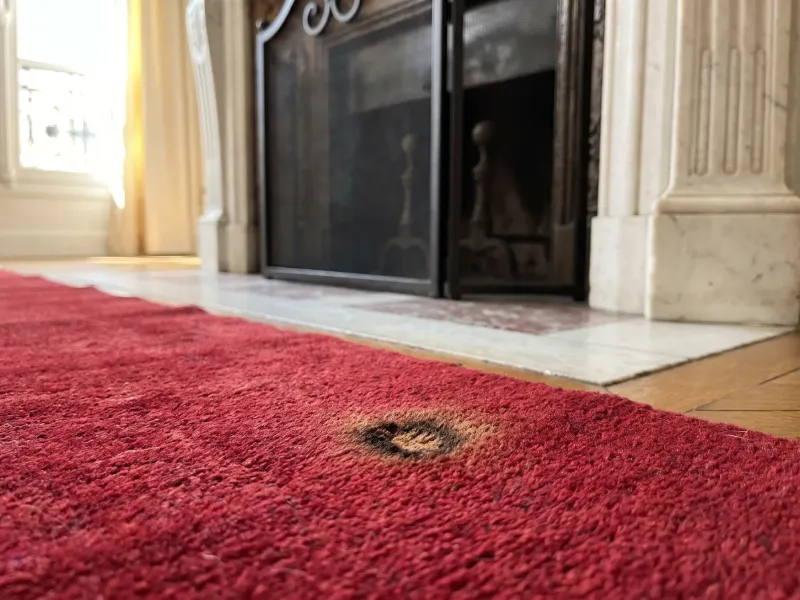
Wool does not burn easily. In contact with an ember it scorches, shrinks and chars on the surface, but it tends to stop burning once the heat source is removed. In most cases the damage therefore stays local: a small brown hollow surrounded by blackened tips.
Other materials behave differently:
- silk tolerates heat far less well; a deep burn leaves a gap that is hard to restore;
- synthetic fibres, found in some machine-made rugs, melt and harden into sticky beads;
- cotton in the warp and weft, on the back of many city rugs, catches more easily than the wool of the pile.
That last point explains why the back matters so much: as long as the foundation is intact, the repair is only a matter of pile.
How deep is it? Tips, knots or foundation
Only the tips
The pile is singed on the surface and the colour has browned, but when you part the fibres you find the original colour at their base. Nothing shows on the back. This is the most common case with a cigarette picked up quickly or a small spark.
Knots affected
The burn forms a hollow: the pile has gone over a small area and you can see blackened knots, sometimes brittle under your finger. On the back the area may be slightly browned, but there is no hole. This usually comes from an ember left for a few moments.
Foundation damaged
The back is marked, hardened or holed. Warp and weft threads have burnt, and the area may open up if it is handled. In that case, avoid rolling or folding the rug at that point and stop walking on it until it is repaired. If the rug has to stay where it is, put a light piece of furniture or a plant just beside the spot to steer people around it, without placing anything on the burn itself.
In all three cases, the smell of burning and the soot often spread beyond the visible mark. A rug that has been in a smoky room benefits from a full wash in our workshop before or after the repair.
What the workshop can repair
The repair depends on the depth, but the principle stays the same: remove what is destroyed and rebuild with materials close to the original.
- For singed tips, careful levelling of the pile is sometimes enough, provided the surface is not dug into. It is a workshop job, done at the right height and in the direction of the pile.
- For burnt knots, the area is re-piled: the charred fibres are taken out and new knots are tied one by one onto the foundation, in a wool chosen for its colour and thickness.
- For a holed foundation, the warp and weft are rebuilt first, then the pile is knotted again on top. It takes longer, but a well-made repair blends into the design.
To price the work, we look at three things in your photos: the area that is really destroyed, once the healthy fibres around the mark are parted; the number of colours running through it, since a fine motif takes more patience than a plain ground; and the knot density, which sets how many knots must be retied. A burn in a plain red field is simpler to repair than one in the middle of a medallion.
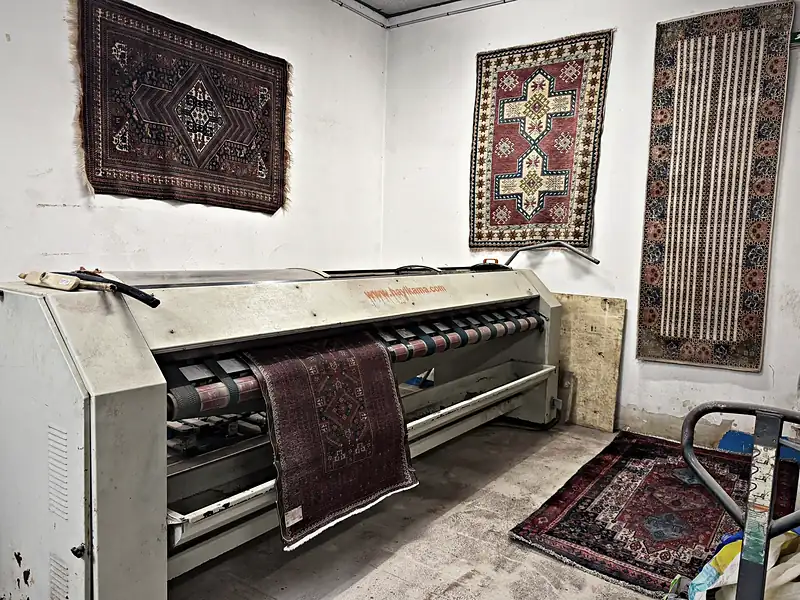
Time and cost vary with the size of the damage, the fineness of the knotting and the number of colours to match. On an ordinary piece, the repair can cost more than the rug is worth: we will tell you before we start. The work we do is described on our rug restoration page, and you can see where and how it is done on the page about our workshop.
During the fire season, a few precautions
In many older flats, the fireplace in the sitting room is rarely or never used. When it still works, the rug in front of the hearth is the first thing at risk, all the more so as fires come back from late October through to the holidays. A few habits prevent most accidents:
- put a fireguard or screen in front of the hearth whenever the fire is lit;
- leave clear space between the edge of the rug and the hearth, or keep a rug of little value in that spot;
- stand candles and tea lights on a stable holder, away from fringes and curtains;
- keep portable heaters, halogen lamps and hot irons off the pile;
- use a heavy, wide-based ashtray if anyone smokes in the room.
And if an accident happens all the same, do not let the damaged spot wear away: an unrepaired burn deepens with foot traffic and ends up reaching the foundation. To find out what can be repaired, send us your photos or call us on 07 49 23 76 50.