
By Orient-Tapis Prestige, Paris 7th · · 5 min read
Key points
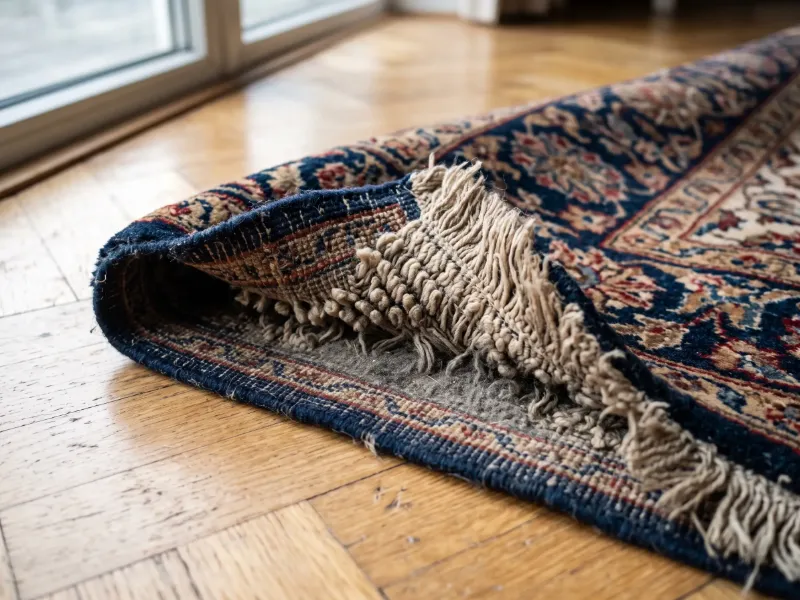
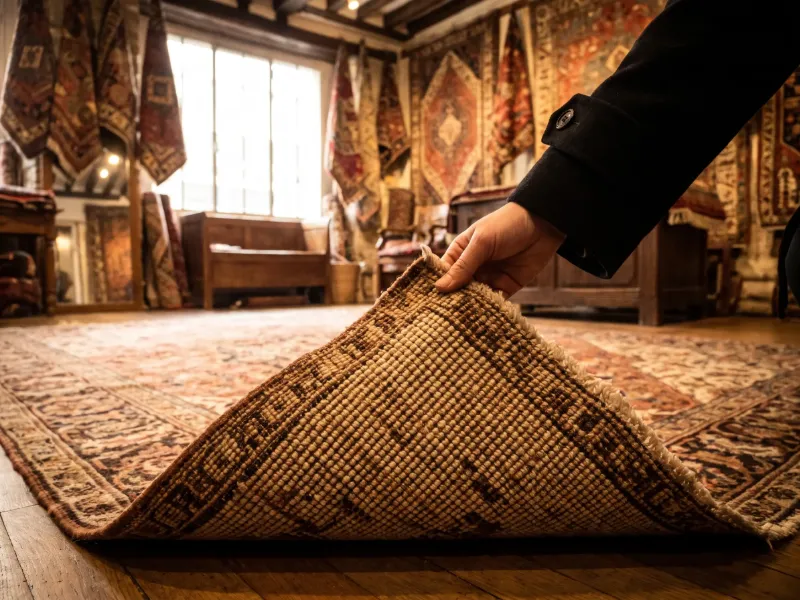
- Always turn the rug over: the back shows the knotting, the repairs and any treatment the front hides.
- Check the shape, the sides and the ends, then part the pile wherever a colour looks too perfect.
- Ask for a written description and, if possible, a trial at home: in a shop, French law gives no cooling-off period.
Start with the back
A serious dealer never minds you turning a rug over. It is in fact the first thing to do, before discussing the design or the colours. On a hand-knotted piece, the pattern reads almost as clearly on the back as on the front, knot by knot. Above all, the back tells you what the front does not show:
- repairs: an area where the knots are larger, tighter or in a different wool gives away a repair, which then needs to be assessed;
- patches: a seam outlining a rectangle or a curve points to a piece sewn in from another rug;
- products: a stiff, shiny or yellowish patch indicates glue or latex, applied to hold a weak area together;
- linings: a cloth sewn over the whole back may be justified on a hanging rug, but it hides the real condition. Ask to look underneath, at least at one corner.
The points we examine, the same whether we are buying or selling, are set out on our valuation and buy-back page.
Check the shape, the sides and the ends
Have the rug fully unrolled, flat, on a hard floor. Step back and look along its length.
The shape
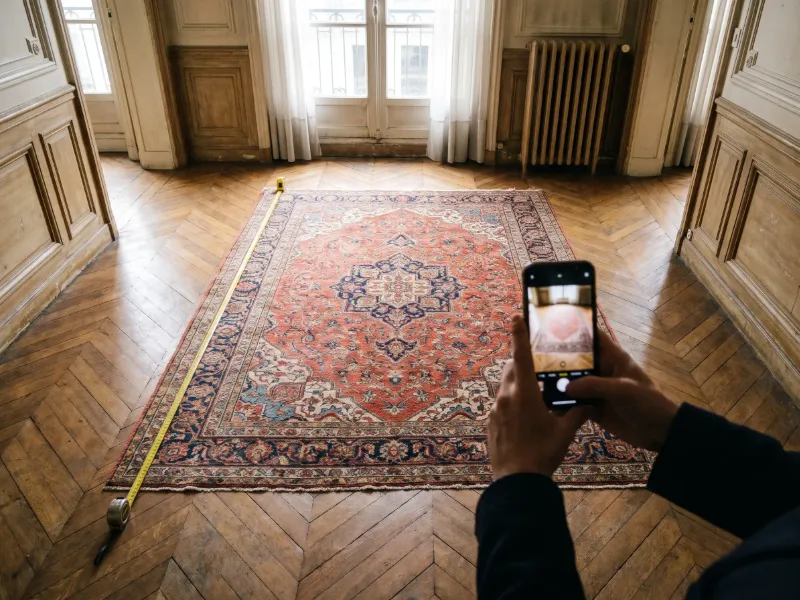
A hand-knotted rug is never a perfect rectangle, and slight irregularity is not a fault, especially on a village or nomadic piece. Sides that curve markedly, one end much narrower than the other, or ripples that will not lie flat do need an explanation. Measure the width at both ends and in the middle, and the length along both sides: large differences often come from poor drying or from a repair that pulled on the foundation.
The sides
The wool wrapping along both sides should be continuous and tight. Where it is missing, the outer warp threads wear quickly and the rug eventually opens up. A rewrapped selvedge is nothing to worry about if it was sewn by hand in a similar wool; a strip sewn on by machine or glued is more of a concern.
The ends
Look at the fringes and the narrow woven band before them. An end that has been heavily shortened may mean part of the border has gone. Fringes sewn under the rug, rather than continuing the warp, are an addition.
Touch and smell
Gently fold a corner back to back, without forcing it. A healthy foundation bends easily and lies flat again. If you hear small cracking sounds, or the rug keeps a sharp crease, the warp and weft may have dried out or rotted after a long stay somewhere damp. This defect does not show on the front and is costly to consolidate. Smell it too: a musty or cellar smell often confirms the suspicion, and it does not always go away with washing.
Reading the colours without being fooled
On an old rug dyed in the traditional way, a single colour often varies in horizontal bands, because the wool came from different dye baths. These shifts, known as abrash, are part of a piece’s charm and are not a defect.
Other differences deserve more attention:
- a colour that stops halfway down: part the pile with two fingers. If the surface colour does not reach the base of the knots, the front has been touched up, with felt-tip or paint, to hide wear;
- a back brighter than the front: the classic sign of a rug left in the sun for years; the fading is then general and cannot be corrected on the surface;
- greyish or dull areas: often just dirt, which washing will deal with. Our guide on whether a rug needs cleaning helps you tell the difference.
Finally, look at the colours in daylight, near a window, from both ends. Under shop lighting, every red looks warm.
What you should get in writing
A written description protects the buyer as much as the seller. Ask for it on the invoice or on an attached document, with:
- the presumed origin and the estimated period, worded with appropriate caution;
- the materials of the pile and the foundation: wool, silk, cotton;
- the dimensions, fringes excluded;
- the condition, and any known repairs, even old ones.
Take your own photos of the front, the back and any flaws when you buy. They give you a point of comparison if a question comes up later, and supporting evidence for your insurer.
If a seller hesitates to put in writing what they told you, take that as information. And note that, as of 24 October 2026, the right of withdrawal under French consumer law covers purchases made at a distance or away from the seller’s premises: a rug paid for in a shop does not benefit from it, unless the dealer agrees otherwise. Before paying, ask clearly what is possible if the piece does not suit once you get it home.
See the rug at home before deciding
Most disappointments come not from the quality of the rug but from the room it goes into. A warm red in the shop turns brown in a north-facing sitting room; a deep blue lightens near a large window. The pile also changes shade depending on the side you look from: laid one way it looks darker and more velvety, the other way lighter and shinier.
That is why we lend the piece you are interested in for a few days, so you can see it in your own light, next to your furniture and on your floor. You can also come and see the selection at the shop, 51 rue de Babylone; a call on 07 49 23 76 50 before you come saves you finding us out on a home visit. The antique, tribal and contemporary pieces we show are described on our collection page.
Living with it for a few days also answers practical questions you cannot settle in a shop: whether the rug slides on your parquet, whether the door clears it, whether the chairs catch on its edge, whether the pile shows every footprint. These are small things, but they decide whether you will still enjoy the piece in ten years.
If your choice falls on a rug that needs a little care, have the work priced before buying rather than after: our restoration page explains what repairs well and what does not.